“The Drilling Rig gave us a true one-stop solution. Their team matched the right rig, compressor, and drilling tools for our project, and the engineering support stayed fast and professional from quote to delivery.”
Why Oversized Compressors Waste Fuel on Borewell Projects
The tender habit nobody wants to admi
Table of Contents
I’ve watched this movie too many times: a buyer asks for a borewell drilling compressor, a sales rep adds “buffer,” then another manager adds more “buffer,” and by the end of the chain the quote has swollen into a bigger diesel package that looks impressive on paper but spends most of its life hauling around unused capacity, extra weight, and an uglier fuel bill. It happens. A lot. DOE’s compressed-air guidance says more than 80% of compressor input energy can end up as heat, and its compressed-air sourcebook is blunt that oversized compressors get inefficient at part-load. That’s not sales folklore; that’s the physics of wasted air and bad control logic. Compressed Air | Better Buildings & Better Plants Initiative and Improving Compressed Air System Performance say it plainly.
And I frankly believe this is where a lot of tenders go crooked—not through fraud, usually, but through laziness dressed up as prudence. Bigger iron, bigger margin, bigger “just in case.” Safer for whom?
CFM talks. The hammer decides.
But here’s the ugly truth: the right air compressor for borewell drilling isn’t the loudest machine in the yard, and it isn’t the one with the fattest brochure spec either; it’s the unit whose delivered CFM and PSI line up with the DTH hammer, the hole diameter, the strata, the target depth, and the rig’s actual working rhythm instead of some imaginary worst-case scenario that never shows up on site. That’s the whole game. Chicago Pneumatic’s published waterwell range runs from 500 to 1250 cfm and 175 to 425 psi, and its model stack ties specific compressor classes to bore diameter and depth—CPS 500-175, CPS 1100-300, CPS 1200-330, CPS 1350-425. That’s a banded engineering decision, not a macho contest. How to select the right compressor for your waterwell drilling needs? – Chicago Pneumatic
So when somebody tells me “more air can’t hurt,” I usually hear, “we didn’t bother matching the package to the tool string.” Different thing.
Your own product pages make the point for me
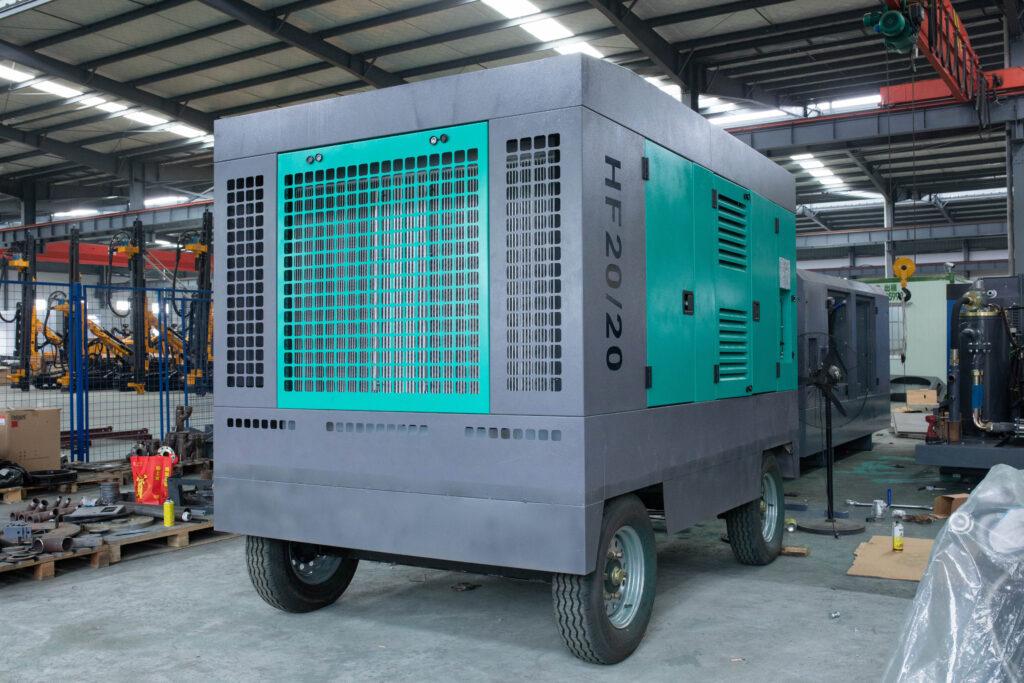
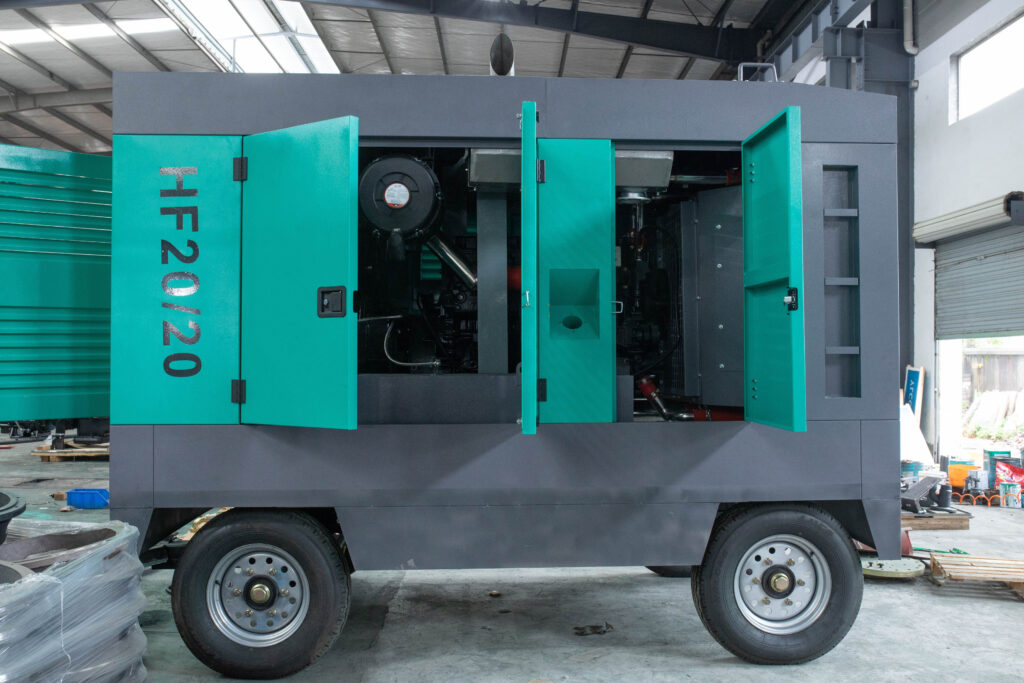
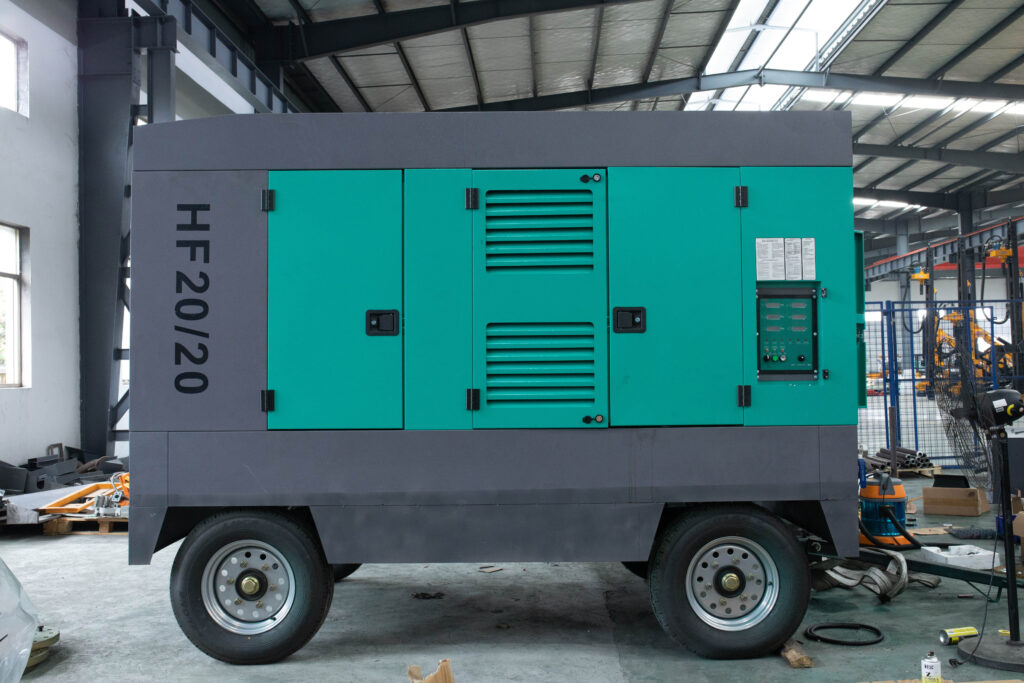
Yet the spec sheets already tell the story—if you read them like a drilling guy, not like a catalog intern. The 330 CFM portable diesel screw air compressor is listed at 330 CFM / 9.5 m³/min and 8 bar. That’s support air or lighter-duty construction territory, not deep DTH borewell work. The 295KW 23 bar portable diesel screw air compressor is listed at 29 cbm and 23 bar—roughly 1024 cfm and 334 psi—and the product page explicitly frames it as a direct-driven water drill compressor. Then the 33 m³/min 3.5 MPa portable diesel engine air compressor jumps to 33 M3/MIN, which is roughly 1165 cfm, with 3.5 MPa pressure, or about 508 psi. Those aren’t cousins. They’re different animals.
And that last unit? That’s where people get carried away. A 33 m³/min / 3.5 MPa package sits above the 175–425 psi waterwell band Chicago Pneumatic publishes, so unless the hammer, bit, formation, and depth target really demand that much headroom, you’re not buying productivity—you’re buying a permanent fuel surcharge with wheels. That’s the kind of spec creep that makes a tender look “serious” while quietly wrecking job economics.
Oversized compressor fuel consumption is where the margin disappears
However, nobody notices the mistake on day one. They notice it a month later, when the diesel ledger starts looking weird and the penetration rate hasn’t moved enough to justify the pain, because oversized packages tend to loaf at part-load, unload badly, cycle badly, and waste power moving compressed air the hole never asked for in the first place. I’ve seen contractors blame the driller, the rock, the bit, the weather—everything except the quote. But the quote is often where the rot started. DOE’s sourcebook states that oversized air compressors are extremely inefficient because many compressors use more energy per unit volume of air when operating at part-load. That line alone should be stapled to every borewell RFQ. Improving Compressed Air System Performance
Then layer fuel reality on top of it. The EIA’s January 2023 short-term outlook projected U.S. retail diesel at about $4.20/gal in 2023 and near $3.70/gal in 2024, while EIA’s diesel explainer says average state taxes and fees on on-highway diesel were 34.74 cents per gallon as of January 1, 2024. That means every “extra-safe” gallon you burn is happening in a market that already punishes waste before you’ve even counted freight, idle time, or the opportunity cost of dragging heavier equipment into the field. Bad combination. Short-Term Energy Outlook and Diesel prices and outlook – U.S. Energy Information Administration (EIA) spell that out.
So, no, I’m not impressed when a quote wins by brute size alone. I want to know what the tool actually needs. That’s the question.
Real-world evidence doesn’t flatter the oversizers
Here’s the part people in this trade like to skip. Compressed-air waste isn’t some academic side note—it shows up in audits, in power bills, in carbon accounting, and in maintenance windows nobody budgets for. A 2024 OSTI-indexed study looking at 206 industrial compressed-air audits over 13 years found potential direct savings of $228 million, creation of 2,025 jobs, and roughly 2.8 million metric tons of CO2 avoided when compressed-air recommendations were implemented. Read that again. Not one site. Two hundred and six audits. Pathway to Decarbonization Through Industrial Energy Efficiency: Micro and Macro Perspectives from Compressed Air Usage
And then there’s the leak side—the grubby side, the real side. The RING Container Technologies: Tackling Energy and Waste Reduction Projects case notes the company found and repaired more than 1,900 cfm of air leaks and delivered annual savings of over 1.5 million kWh. Different industry, yes. Same lesson, absolutely: when the system is sloppy, more compressor doesn’t rescue you. It just feeds the leak harder.
From my experience, that’s exactly how borewell buyers get trapped. They assume a bigger package will cover poor sizing, poor hose discipline, pressure drops, wrong hammer selection, or a vague drilling brief. It won’t. It just masks bad engineering for a few weeks.
A practical sizing lens for borewell tenders
And this is where I stop listening to tender poetry and start looking at the load profile. Not the fantasy load. The actual one.
The table below is how I’d frame the decision before a quote goes out. I’m keeping it exactly as-is because, frankly, it already says what needs saying.
Tender situation
Demand signal
What I would quote
What I would avoid
Why it matters
General construction or support air, not deep DTH borewell work
Yet most RFQs still miss the basics. I want the hammer model. I want target hole diameter. I want depth, altitude, expected water table, formation notes, and delivered flow at working pressure—not brochure flow, not bench-top fantasy, delivered flow. And I want duty-cycle honesty, because a machine that looks heroic on a spreadsheet can behave like a fuel-wasting dog once it starts unloading all day on a medium well. That’s exactly why DOE’s AIRMaster+ | Department of Energy exists: it’s built to baseline compressed-air systems, model part-load operation, and evaluate energy and dollar savings from system changes. In other words, measure first, brag later.
And one more thing. People love to say they want the “best air compressor for deep borewell drilling.” I hate that phrase. It usually means they haven’t defined the job. The best machine for a 6.5-inch hole to 800 feet is not automatically the best machine for a deeper, harder, higher-pressure program—and it sure isn’t the best machine for a lighter job where a smaller package would keep the rig moving without setting money on fire.
FAQs
What is an oversized borewell drilling compressor?
An oversized borewell drilling compressor is a compressor package whose delivered airflow and pressure materially exceed the real operating demand of the DTH hammer, bore diameter, depth, and geology, which forces the machine to spend too much time in inefficient part-load operation while raising fuel, capex, and transport costs without a proportional drilling gain. Improving Compressed Air System Performance
That’s the clean definition. The messier field version is simpler: you bought more iron than the hole can use.
How do I size a compressor for borewell drilling?
Sizing a compressor for borewell drilling means matching the compressor’s delivered CFM and PSI to the hammer model, hole diameter, drilling depth, expected strata, and site conditions, then choosing the smallest package that can sustain the job with a sensible margin instead of piling on excess pressure and airflow for emotional comfort. How to select the right compressor for your waterwell drilling needs? – Chicago Pneumatic
So, yes, start with the published range—but finish with the actual tool string. That’s where buyers get lazy.
Does higher PSI always drill faster?
Higher PSI does not always drill faster because drilling speed improves only when the hammer, bit, flushing needs, and rock conditions can convert the added pressure and airflow into useful work, which means pressure above the effective operating range can become an expensive surplus instead of a productivity gain. How to select the right compressor for your waterwell drilling needs? – Chicago Pneumatic
I’ve seen this confused again and again. More pressure looks clever in a tender. Downhole, sometimes it’s just noise.
Is an electric screw compressor suitable for borewell projects?
An electric screw compressor is suitable for borewell work only when the application is stationary, grid-supported, and aligned with workshop or plant air demand, because a field borewell package is designed around mobile high-pressure drilling duty while a fixed electric unit is generally engineered for factory compressed-air service instead. The 30KW electric screw air compressor page itself describes it as a stationary air-cooled compressor for factory compressed air systems.
So don’t blur those categories. A shop compressor isn’t a water-well package just because both move air.
Stop quoting by fear
I’ll put it bluntly. If the quote doesn’t show the required CFM and PSI for borewell drilling, the hammer logic, the expected duty cycle, and a real reason for the pressure reserve, I don’t trust it. Not fully. Maybe it still works. Usually. But that isn’t the same as being efficient, and it definitely isn’t the same as being profitable.