“The Drilling Rig gave us a true one-stop solution. Their team matched the right rig, compressor, and drilling tools for our project, and the engineering support stayed fast and professional from quote to delivery.”
Why Undersized Compressors Damage DTH Hammers and Drill Bits
The Compressor Is Not “Just an Accessory”
I’ve watched buyers negotiate a drilling rig like grown adults, then choose the compressor like they’re buying a spare tire.
Bad move.
A DTH drilling compressor isn’t sitting on the side of the jobsite doing polite support work; it’s feeding the hammer, clearing the hole, cooling the bit face, moving cuttings, fighting backpressure, and deciding—quietly, brutally—whether the crew drills productive meters or spends the afternoon listening to a hammer choke itself underground.
And here’s the ugly truth: a lot of “bad hammer” complaints are really bad air-package complaints.
Table of Contents
Not always. But often.
The customer says the DTH hammer failed. The dealer blames the operator. The operator blames the rock. Somebody blames the bit factory. Meanwhile, the compressor has been wheezing at the edge of its chart since 10 a.m., the hose run is too long, the filters are dirty, and the bit face has been chewing the same cuttings over and over like a rock crusher with no discharge chute.
That’s not drilling. That’s abuse.
A properly matched DTH drilling compressor has to deliver enough pressure to keep the hammer striking properly and enough CFM to move cuttings out of the hole. If one side is weak, the whole drilling package gets weird. Hammer rhythm changes. Penetration drops. The bit heats up. Wear goes sideways.
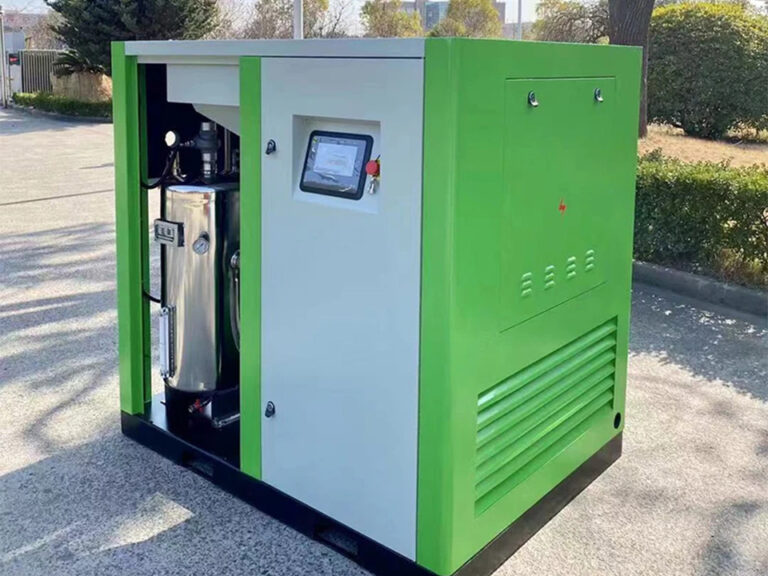
For electric compressor setups, the buyer shouldn’t only ask, “How many kilowatts?” A 37 kW rotary screw air compressor for industrial drilling support may fit some shallow, workshop, or auxiliary air needs, but deeper DTH work is a different animal. Hammer size, borehole diameter, depth, formation, altitude, hose length—miss one of these, and the invoice savings disappear in consumables.
Downhole, Weak Air Turns Into Mechanical Punishment
The hole doesn’t care about your catalog.
It doesn’t care that the compressor was “almost enough” on paper, or that the buyer wanted to save freight cost, or that another supplier promised the same rig could run with a smaller air package. Once the hammer is downhole, physics starts collecting payment.
An undersized compressor for DTH drilling usually creates two problems at the same time: weak hammer energy and poor hole cleaning. That’s a nasty pair. The piston may still cycle, yes, but it cycles with less authority, more instability, and less useful impact. Meanwhile, cuttings don’t evacuate fast enough through the annulus.
Then the bit starts re-drilling trash.
That’s the part many office buyers don’t picture clearly. Rock cuttings are not soft dust once they’re trapped near the bit face. In abrasive formations, especially quartz-rich ground containing silicon dioxide, SiO₂, those cuttings become grinding media. The carbide buttons don’t just hit fresh rock. They hit broken rock, crushed rock, half-lifted chips, and whatever abrasive slurry or dry fines are circulating near the face.
It gets ugly fast.
OSHA’s respirable crystalline silica standard says construction exposure rules apply unless exposure stays below 25 µg/m³ as an 8-hour time-weighted average, and it also restricts compressed-air cleaning where it creates dust without proper control. That rule is about worker health, not bit life, but it tells you something important: compressed air moves fine rock particles aggressively. Dust and cuttings are not harmless byproducts. They are part of the drilling system’s risk profile. See the OSHA respirable crystalline silica standard.
NIOSH says the same thing from a mining-control angle: drilling dust is generated as cuttings are bailed from the hole by compressed air. That’s the clean technical phrase. In field language? The compressor is the broom, the exhaust fan, and part of the cooling system all at once. Read the NIOSH discussion on compressed-air flushing and drill dust control.
No broom, no clean floor.
PSI Hits. CFM Cleans. Don’t Confuse Them.
I frankly believe half the compressor mistakes in small and mid-range water well drilling come from mixing up PSI and CFM.
Pressure gives the hammer force. Volume gives the hole cleanup.
Simple? Yes. Ignored? Constantly.
A compressor can show attractive pressure but still be short on usable air volume. Another unit can produce decent air at the outlet but lose practical performance through narrow hoses, long pipe runs, bad fittings, clogged filters, wet air, altitude derating, leakage, and backpressure from a deep or tight hole.
That’s why “17 bar” by itself doesn’t impress me. Neither does “20 m³/min” by itself. I want to know where that air is measured, at what pressure, in what temperature, through what hose, with what hammer, at what depth, in what borehole diameter.
Annoying questions? Good. They save bits.
If a hammer needs a stable air supply and the compressor is constantly sagging under load, the hammer doesn’t just slow down politely. It starts operating outside its happy zone. The piston impact becomes weaker. Blow frequency may sound wrong. Cuttings return gets dirty, lazy, or intermittent. The bit face overheats. The shank and splines take nasty, uneven loads.
Button cracking, face erosion, bearing surface abuse
Lost shifts, failed bits, angry buyer
Poor air quality or condensate
Water/oil contamination, erratic performance
Corrosion risk and lubrication disturbance
Thermal shock and uneven wear
Maintenance disputes and warranty friction
That table is not theory for a classroom. It’s the pattern you see when a buyer tries to run a hammer with barely enough compressor on day one, then wonders why day thirty looks expensive.
Poor Flushing Is Where Drill Bits Go to Die
Sometimes the first warning is not a broken hammer.
It’s the bit.
The buttons look worn too fast. The face looks sandblasted. The gauge side gets eaten. Penetration slows, so the driller leans harder on feed pressure—because what else is he supposed to do when the boss is asking for meters? Then the bit wears even faster.
Bad loop.
Poor hole flushing DTH drilling is a consumables killer because the bit is forced to work in dirty impact conditions. Clean drilling means the bit strikes fresh rock and the cuttings leave the face area quickly. Dirty drilling means the bit strikes broken material again and again. That wastes energy and creates heat.
And heat is a thief.
It steals carbide life. It stresses the steel body. It makes wear less predictable. In some formations, especially fractured hard rock, the bit can start to look like the supplier used bad material. Maybe the supplier did. But many times? No. The compressor package was simply too weak for the hammer, hole size, depth, and ground.
From my experience, buyers love comparing bit prices because it feels easy. One bit is $180. Another is $260. Fine. But if poor flushing cuts usable bit life by 30%, that cheap bit discussion becomes background noise.
The more serious question is this: how many meters per bit, per hammer, per liter of diesel, per shift?
That’s where the money is hiding.
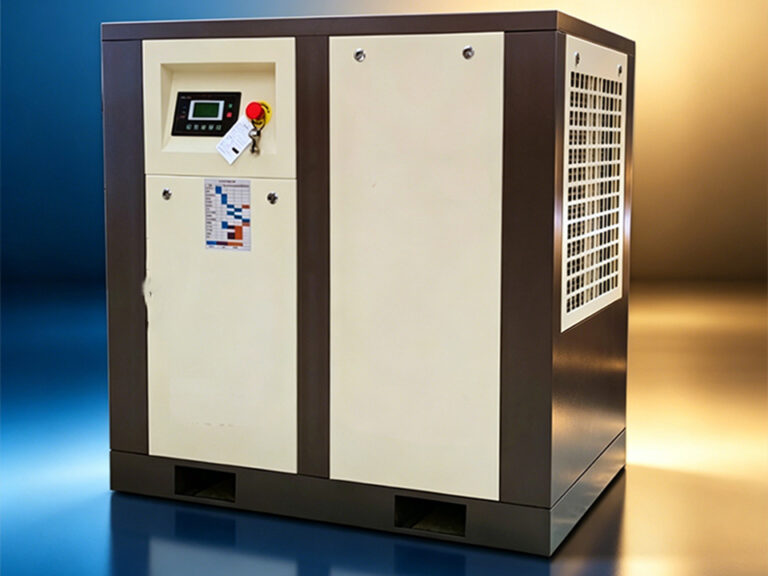
For buyers looking at controllable industrial air packages, a two-stage variable-frequency PMVF37 screw air compressor can make sense in the right environment. Variable frequency can help when air demand changes. But no VFD, no PM motor, no shiny cabinet fixes a compressor that doesn’t meet the hammer’s real air consumption at working pressure.
A weak air package is still weak.
The “Small Compressor Saves Money” Myth
But doesn’t a smaller compressor burn less energy?
Maybe. On paper. For five minutes.
In real DTH drilling, the better question is not “What does the compressor consume per hour?” It’s “What does the whole package consume per meter drilled?” That one makes cheap compressors look less heroic.
If the compressor is undersized, drilling slows down. The crew stays longer. The machine idles more. The hammer runs in unstable conditions. Bits wear faster. Stuck-tool risk rises. The buyer may save on purchase price and then bleed money through hours, fuel, hammer parts, and drill bits.
That’s not a bargain. That’s delayed billing.
The U.S. Department of Energy has long treated compressed air as one of the expensive industrial utilities, with tools such as AIRMaster+ used to evaluate compressed-air system performance. Their point is not about DTH drilling specifically, but it matters here: compressed air is expensive, and bad system design wastes money. See the DOE’s AIRMaster+ compressed air system tool.
Older DOE and ENERGY STAR material is even blunter: compressed air can be one of the most expensive plant utilities, and typical system efficiency can be as low as 10–15%. That’s for industrial plants, not a dusty borehole site, but the lesson travels well. Wasted compressed air is expensive air. See ENERGY STAR’s guide on the cost of compressed air.
So when a buyer says, “Can I use a smaller compressor?” I don’t immediately say no.
I ask: smaller than what, for which hammer, at what pressure, for which hole size, at what depth, in what rock, at what altitude?
Then we talk.
A 15 kW two-stage electric rotary screw air compressor can be a sensible choice for smaller industrial air demand, service work, or controlled applications. But forcing a light compressor into a DTH job beyond its real air capacity is like asking a small pump to dewater a flooded pit. It may run. It won’t win.
The Hammer Sound Tells on You
Old drillers listen.
New buyers stare at spec sheets.
A healthy DTH hammer has a sharp rhythm. Not musical, exactly, but steady. When the compressor starts falling behind, that rhythm changes. The exhaust note gets lazy. The striking feels weak. Pressure needles dance. Cuttings return becomes inconsistent. Sometimes the crew says, “The hammer doesn’t bite.”
That phrase matters.
DTH hammer air pressure instability usually comes from one of the usual suspects: compressor undercapacity, long hoses, small hose diameter, leaks, clogged filters, water in the line, worn compressor valves, bad receiver setup, wrong hammer size, or a hole depth that has outgrown the original air plan.
And yes, sometimes the hammer itself is worn. I’m not pretending every problem is the compressor.
But here’s my bias: check the air before blaming the steel.
Weak Impact Energy
The piston may still cycle, but not with the right strike energy. Penetration falls. The operator adds feed pressure. Maybe more rotation. Now the bit is being pushed harder while the face is still dirty. That’s not a fix. That’s a shortcut to wear.
Dirty Cuttings Return
CFM shortage reduces uphole velocity. The chips don’t leave cleanly. The bit face gets crowded. Backpressure rises. The hammer becomes less efficient. Everything feels heavier.
Heat, Shock, and Weird Wear
Heat doesn’t ask permission. It builds around the bit face, across the shank, through hammer internals, and anywhere energy is being wasted instead of transferred into clean rock breakage. Then wear becomes uneven. Buttons chip. Faces erode. Splines complain.
That’s why compressor undercapacity drilling problems often look like random failure.
They’re not random.
Dealers Need to Stop Selling Air Like a Checkbox
“Depth?”
That’s the lazy first question.
Of course depth matters. But it’s not enough. If a dealer recommends a compressor based only on drilling depth, I’d be nervous. We need hammer diameter, borehole diameter, casing plan, formation type, altitude, temperature, hose length, fuel or power availability, expected duty cycle, water injection, and whether the customer wants cheap entry price or predictable meter cost.
Different answer. Different package.
A 4-inch hammer in moderate ground doesn’t need the same air strategy as a 6-inch hammer in fractured basalt. A 150 m village water well is not a 300 m commercial drilling contract. A sea-level compressor package may disappoint in high-altitude terrain. Tight annulus? That changes flushing velocity. Long hose run? More pressure drop. Bad fittings? More leakage.
Everything steals air.
For heavier stationary or semi-stationary setups, a 75 kW portable and stationary compressor pump configuration gives the conversation more room: duty cycle, working pressure, real air delivery, serviceability, and lifecycle cost. That’s a better sales discussion than “lowest price, please.”
Here’s the dealer line I’d use:
The compressor is not powering the hammer. It’s protecting the hammer.
That sentence lands.
A Field-Useful Way to Size a DTH Compressor
Don’t start with the compressor.
Start with the hammer. Then the hole. Then the rock. Then the site.
My usual sizing logic looks like this:
Confirm hammer diameter and rated working pressure.
Check hammer air consumption at that pressure, not at fantasy conditions.
Match borehole diameter and annular velocity for cuttings removal.
Adjust for depth, altitude, ambient temperature, hose length, and leakage.
Add margin. Real sites are never as clean as brochures.
Check compressor output at working pressure, not just free-air delivery claims.
Inspect air quality: condensate, oil carryover, filtration, cooling, and maintenance access.
Train the crew to treat hammer sound as a warning signal, not background noise.
The margin point matters. Some buyers hate margin because it costs money. I get it. But zero-margin compressor selection is how you end up with a rig package that performs nicely during the first shallow demo and disappoints when the real job starts.
The demo hole lies.
The jobsite tells the truth.
Why Buyers in 2026 Are Especially Vulnerable to This Mistake
Buyers are squeezed.
Freight is expensive. Customs are annoying. Local financing is weak in many rural drilling markets. Contractors want to start with less capital. Dealers are fighting price wars on WhatsApp. Everybody has screenshots from three other suppliers.
So yes, the buyer asks for the smaller compressor.
I don’t blame them. I blame suppliers who say yes without doing the air math.
Because once that package reaches the field, the customer doesn’t remember that they asked for the cheapest option. They remember that the hammer is weak, the bit wore out, the meters are slow, and the supplier “sold them a bad machine.”
That’s how trust gets destroyed.
A serious OEM or dealer should move the conversation away from purchase price alone and toward lifecycle cost: meters per shift, fuel per meter, hammer service interval, bit life, flushing quality, downtime risk, and operator skill level.
That’s sales-enablement content with teeth.
FAQs
How does an undersized compressor damage DTH hammers?
An undersized compressor damages DTH hammers by starving the tool of stable air pressure and enough airflow, which causes weak piston impact, irregular cycling, poor internal cooling, higher backpressure, and faster wear on pistons, valves, shanks, splines, and other hammer contact surfaces.
In plain field language, the hammer is trying to work while breathing through a straw. It may still make noise. It may still drill a little. But the strike energy gets inconsistent, and that inconsistency beats up the internals over time.
Why does low CFM cause DTH drill bit wear?
Low CFM causes DTH drill bit wear because weak airflow cannot remove cuttings fast enough from the bit face, forcing carbide buttons to strike broken abrasive particles instead of clean rock, which increases heat, face erosion, button stress, gauge wear, and uneven carbide damage.
That’s the hidden killer. The bit isn’t only drilling formation anymore. It’s drilling its own waste. In quartz-heavy ground, that waste acts like abrasive media, and the bit face pays for it.
Is PSI or CFM more important for DTH drilling?
PSI and CFM are both important for DTH drilling because pressure supports hammer impact energy while CFM controls flushing, cooling, and cuttings removal; pressure without enough airflow can still create poor hole cleaning, unstable hammer behavior, excessive heat, and premature drill bit wear.
If someone sells only on bar or PSI, be careful. If someone sells only on CFM, be careful too. DTH drilling needs the correct pressure-flow combination under real working conditions.
What are the signs of compressor undercapacity drilling problems?
Compressor undercapacity drilling problems usually show up as slow penetration, weak hammer sound, unstable gauge pressure, poor cuttings return, excessive bit heat, frequent button wear, stuck tools, high fuel per meter, and operator complaints that the hammer feels lazy or inconsistent.
The trap is misdiagnosis. These symptoms often get blamed on bad bits, bad hammers, or bad operators. Sometimes that’s true. But check compressor output, hose losses, leakage, filters, condensate, and hammer sizing before blaming the consumables.
Can a bigger compressor reduce DTH hammer damage?
A properly sized compressor can reduce DTH hammer damage by delivering stable working pressure and enough CFM for hammer cycling, cuttings evacuation, cooling, and cleaner impact conditions, but oversizing without good controls, air quality management, and correct hammer matching can still waste fuel.
Bigger is not automatically smarter. Correct is smarter. The goal is not to buy the largest compressor in the yard; the goal is to supply the hammer and hole with enough clean, stable air under actual drilling conditions.
Your Next Steps: Price the Air Before You Price the Hammer
Before choosing a DTH drilling compressor, don’t ask only for price.
Ask for the air match.
Send the hammer size, hole diameter, target depth, formation type, altitude, hose length, and power or diesel preference. Then check whether the compressor can hold the required working pressure and CFM with margin—not just during a shallow test, but when the hole gets deeper and the cuttings load gets ugly.
Because the cheapest compressor is only cheap until it starts eating hammers and drill bits.
After that, it’s just an expensive lesson with a nice paint job.